
Asset Intelligence Platform
Turning Asset Intelligence into Revenue & Uptime
Asset Intelligence transforms installed equipment into a continuously learning ecosystem that helps OEMs uncover aftermarket revenue opportunities and enables manufacturers to predict failures and prevent downtime.
The Foundation
What is Asset Intelligence?
Asset Intelligence converts equipment data into business value.
For OEMs, it reveals installed base insights that unlock aftermarket opportunities, improve service planning, and drive parts revenue.
For manufacturers, it enables predictive maintenance that reduces downtime, improves reliability, and protects production.
The outcome: smarter decisions, lower risk, and higher lifecycle returns.
For OEMs
Unlock aftermarket revenue by transforming installed base data into service opportunities, warranty intelligence, and predictive parts demand.
For Manufacturers
Maximize production uptime with predictive maintenance triggers, failure pattern learning, and AI-driven asset health scoring.
Impact
Business Value
Predict Failures Before They Happen
Strengthen OEM Service Models
Leverage equipment telemetry, historical failure modes, and real-world usage patterns to anticipate issues before they impact customers. Reduce warranty claims, improve service-level performance, and enhance brand trust through proactive support.
01
Optimize Maintenance Spend
Boost Manufacturing Throughput
Transition plants from fixed-interval maintenance to condition-based and predictive strategies. Minimize unnecessary service tasks, reduce spare-parts consumption, and keep production lines running at peak efficiency.
02
Improve Asset Lifecycle Value
Increase OEM Revenue & Customer ROI
Extend asset life through smarter maintenance interventions and optimized operating conditions. Enable OEMs to offer higher-value service contracts and performance-based maintenance models while helping manufacturers lower total cost of ownership.
03
Strengthen Safety & Reliability
Protect People and Production
Early detection of anomalies reduces the likelihood of equipment-related safety incidents. Improve reliability across fleets and production environments, supporting compliance and reducing costly unplanned downtime.
04
Audience
Who Benefits
OEMs
Manufacturers & Plant Operators
Product
Core Capabilities
Installed Base Visibility
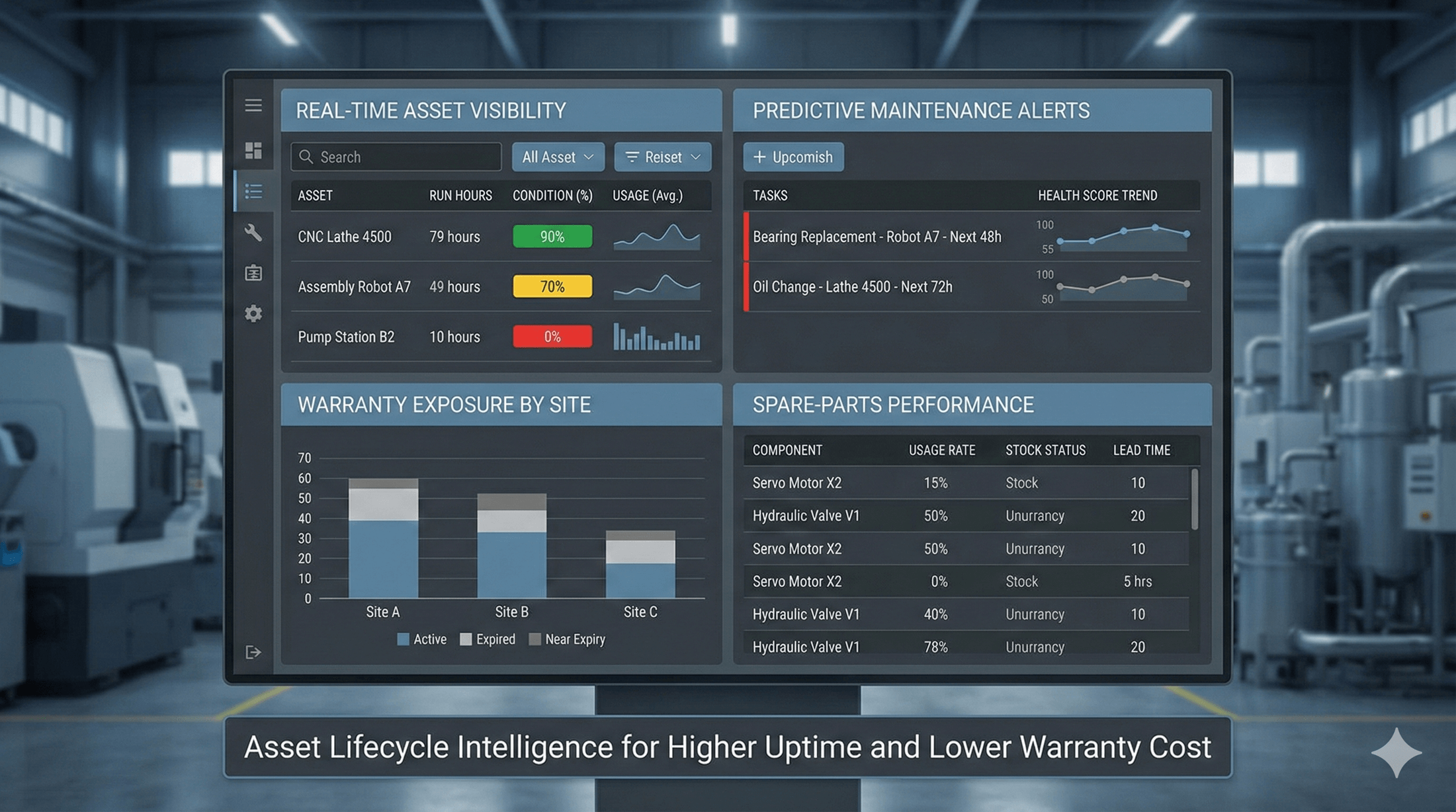
Gain a clear view of where assets are, how they are used, and their current health status.
Run-Hour & Condition Monitoring
Track usage patterns and equipment condition in real time to detect abnormal behavior.
AI-Driven Maintenance Triggers
Automatically generate alerts and recommendations based on data trends.
Failure Pattern Learning
Leverage historical data and FMEA insights to continuously improve prediction accuracy.
Smart Parts & Service Recommendations
Recommend the right intervention, parts, and timing to minimize downtime.
Methodology
Our Approach
We integrate data, analytics, and domain expertise to build an intelligence layer over your installed assets. This enables continuous learning and smarter decision-making across maintenance, service, and operations.
Instead of reacting to aftermarket opportunities and machine breakdowns, your organization gains the confidence to plan, predict, and prevent.
01
Integrate
Connect telemetry, ERP, CMMS, and warranty data sources
02
Analyze
Apply ML models, risk scoring, and failure learning
03
Act
Drive smarter maintenance, service, and parts decisions
Our Promise
We unlock predictive intelligence inside your assets so you can deliver smarter service, safer operations, and stronger production outcomes.
Methodology
Ready to Unlock Predictive Intelligence in Your Assets?
Confidential executive session focused on your operational metrics.